


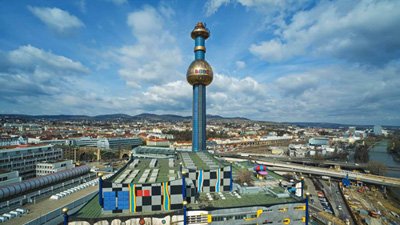
WKU has been commissioned by wien energie gmbh (wien energie) to provide planning services for the revamping of the waste INCINERATION plant Spittelau. These planning services include highly complex engineering work.
Wien Energie draws on WKU’s extensive know-how and thereby leverages the resources available at the City of Vienna. Wien Energie operates a two-lane thermal waste treatment plant for household waste and comparable commercial waste at Spittelauer Lände 45 in Vienna's 9th city district. The waste incineration plant Spittelau processes around 250,000 tonnes of household waste per year, producing:
- 120,000 megawatt hours of electricity
- 500,000 megawatt hours of district heating
- 6,000 tonnes of scrap iron
- 60,000 tonnes of slags, ashes and filter cake
The Spittelau plant supplies more than 60,000 Viennese households in Vienna with eco-friendly heat and 50,000 households with electricity every year.
Hundertwasser's great work of art
The waste incineration plant Spittelau was built in the years 1969-1971. In 1987, a fire destroyed large parts of it. But instead of demolishing its remnants, the plant was rebuilt in the same place. The two main reasons were:
At Spittelau, the complete district heating technology was available.
The waste was incinerated right where it originated: in the middle of the city.
Helmut Zilk, Mayor of Vienna at the time, wanted to take the restoration activities even one step further: The new Spittelau should be particularly clean and set new standards in environmental protection; and it should become a work of art. The environmentalist, nature lover and artist Friedensreich Hundertwasser was retained to design the new plant.
In 1992 the building was finished. With its colourful facade, the golden ball on the vent, the green roofs and tree plantings, the new Spittelau had become a unique structure - and a Viennese landmark such as St. Stephen's Cathedral and the Giant Ferris Wheel.
What's behind the colorful facade?
The delivered waste is initially weighed by a weighbridge and temporarily stored in a waste container with a capacity of 7,000 cubic metres. A gripper arm carries the waste to the two waste furnaces, where it is burned.
The resulting hot flue gases are passed through a heat exchanger that generates steam. In a further step, district heat and electricity are produced. The Spittelau plant is equipped with a number of state-of-the-art systems for cleaning the flue gases produced during combustion. The cleaned flue gases are finally released into the atmosphere through a 126-metre-high chimney.